
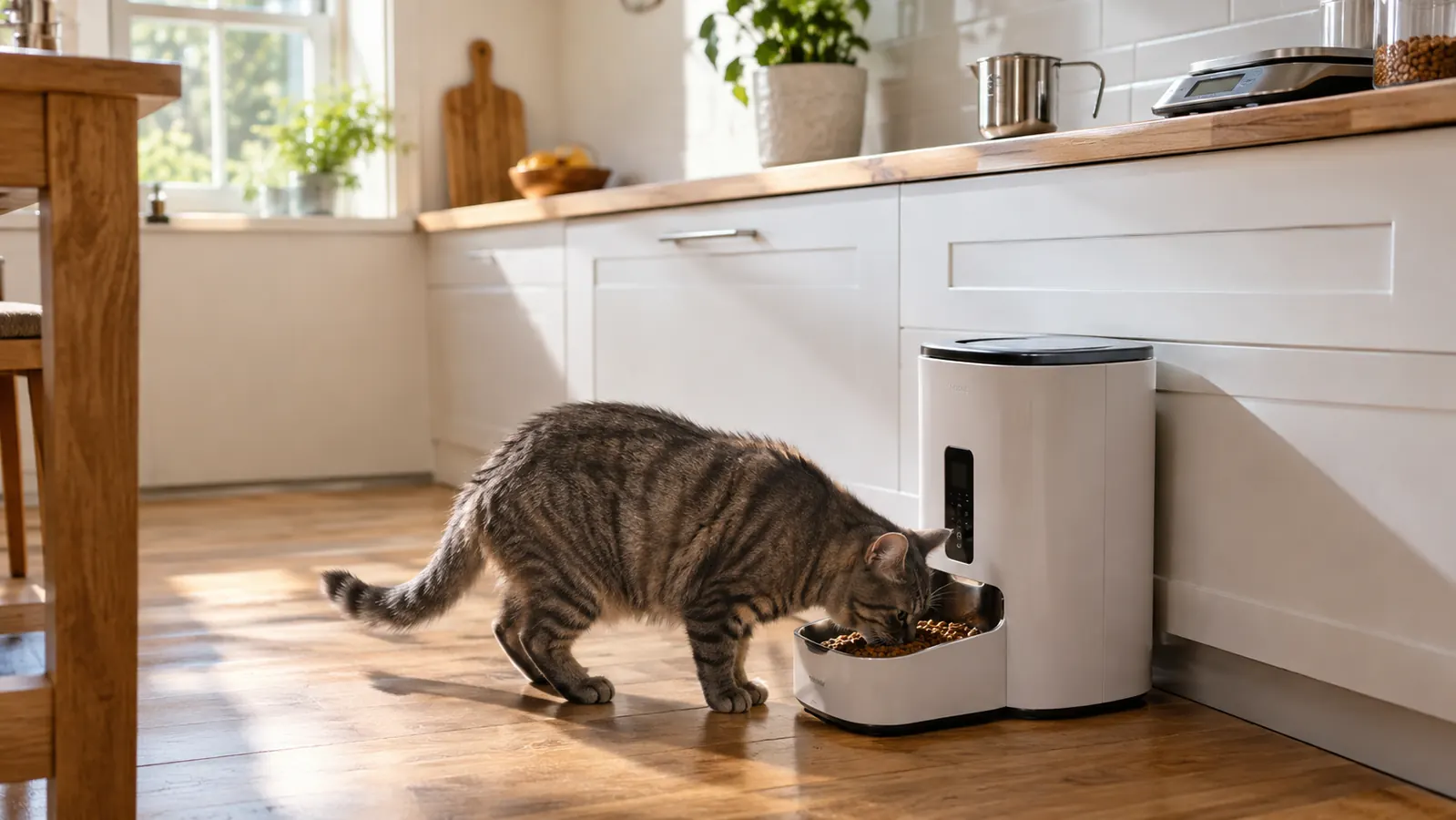
My gray tabby Juniper has strong opinions about food, and for years I let her win. I would fill her bowl in the morning, she would inhale half of it, then cry at me by 3 p.m. like she had never been fed in her life. At her annual checkup last year, the scale told the real story. Juniper, 11 years old and about 11 pounds, had put on a little extra weight, and my vet gently suggested we talk about portions. I have worked the front desk at a small animal clinic in Allentown for twelve years, so I knew exactly what she meant. I also knew that measuring one big bowl of kibble was not going to fix anything, because Juniper does not eat like a reasonable cat. She eats like a tiny furry vacuum.
That is how I ended up with the Voluas Automatic Cat Feeder, a 4L timed dry food dispenser that lets me split Juniper's daily portion into several small meals without standing next to the bowl with a timer. This is the schedule and the setup that finally worked for us, after a few false starts I will tell you about, because the feeder is only half of the solution. The other half is deciding what a portion actually means for your cat, and then making the machine stick to it.
Stop guessing at the portion. Let the feeder measure it.
The Voluas Automatic Cat Feeder holds up to 4 liters of kibble and dispenses set portions on a schedule you control. It is the closest thing I have found to a feeding routine that runs itself.
Amazon Check Today's Price on Amazon →Step 1: Figure out the daily portion before you touch the feeder
The first mistake I made was setting up the feeder before I knew how much Juniper should actually eat. I had the machine on the counter, the app open, and no idea what number to put in. So I did what I tell every owner who calls the clinic with the same question: I checked the bag, then I checked with the vet. The feeding guide on your cat food bag gives a range, usually by weight, and that range is your starting point. For an 11-pound indoor cat like Juniper, the number on the bag was somewhere around 200 to 250 calories a day, depending on the food. My vet helped me pick a target at the lower end of that range, since Juniper is not a kitten and does not spend her days hunting anything more demanding than a sunbeam.
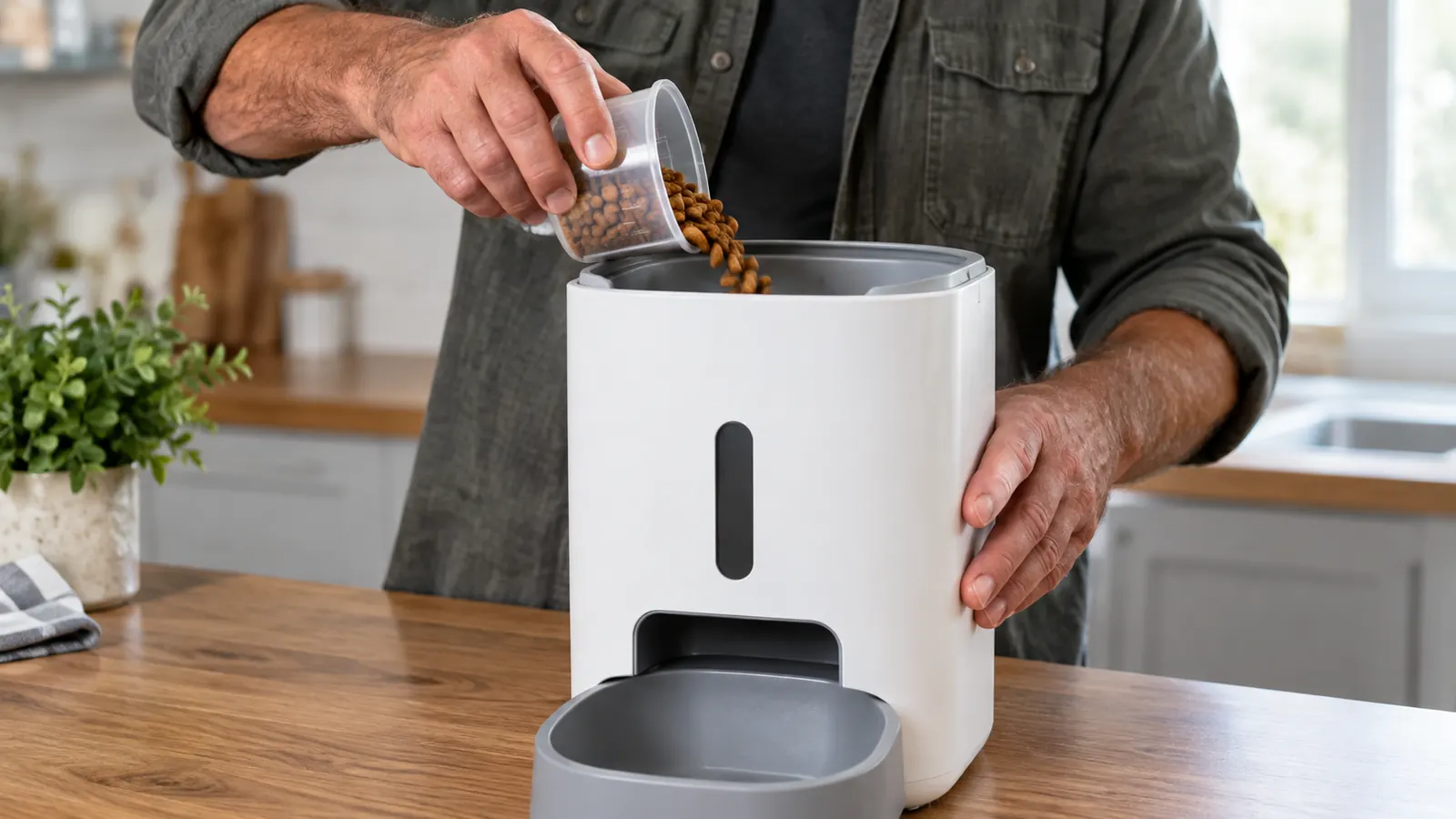
Here is the part people skip: a portion is a weight or a calorie target, not a scoop size. The little cup that comes with the Voluas feeder is convenient, but the first time I used it I filled it with a heaping scoop and called it a portion. That is how you end up overfeeding a cat while feeling very organized. Use a kitchen scale for the first few days, weigh the kibble that goes into each meal, and write down the number. Once you know that your cat's daily target is, say, 60 grams of food, you can divide that into meals and let the feeder handle the rest.
If your cat has a medical condition, diabetes, kidney issues, or a history of urinary problems, do not guess. Ask your vet for a calorie target. I am not a vet, I just answer the phones and clean the coffee maker, and the one thing I have learned in twelve years at the clinic is that portion size is a medical question for some cats and a math question for the rest of us.
Step 2: Split the daily portion into meals that match your cat's rhythm
Cats are not built to eat one big meal a day. In the wild they eat small meals throughout the day, and a lot of indoor cats, Juniper included, do better when their daily food arrives in several smaller portions. The Voluas feeder lets me program up to four meals a day, and that turned out to be the sweet spot for us. I set breakfast at 7 a.m., a small lunch at noon, an early dinner at 5 p.m., and a tiny bedtime snack at 9 p.m. Juniper gets the same total amount of food she always got, just split into four smaller arrivals.
The change in her behavior was almost immediate. She stopped camping out next to her bowl at 3 p.m. because she knew, in the way cats know things, that food would arrive at 5. She also stopped gulping, because each portion was small enough that she could eat it slowly without feeling like she had to defend it from an imaginary rival. The feeder's dispenser releases a set amount each time, so the portion is the same every single day, which matters more than I expected. Cats are creatures of habit, and Juniper now treats the feeder's little whir like a doorbell she has been waiting for.
Start with the number of meals your schedule can support. If you are out of the house for ten hours, program a meal for the middle of the day. If you work from home like I do on Tuesdays, you can still use the feeder to keep portions honest, because the machine does not care whether you are in the next room. The point is to match the meal count to your cat's natural rhythm and your own schedule, not to the number of times you remember to fill a bowl.
Step 3: Set the portion size on the feeder and test it twice
The Voluas feeder has a portion dial that controls how much kibble each meal dispenses, and this is where I made my second mistake. I set the dial, pressed the test button, watched a small amount of kibble fall into the tray, and declared it done. The next morning, breakfast was about half the size I intended, because I had not actually measured what the dial setting produced. The feeder was doing exactly what I told it to do. I just had not told it the right thing.
Fix that by testing with the food you actually use. Fill the hopper, set the dial to your first guess, and run a manual portion into a bowl on your kitchen scale. Weigh it. Adjust the dial, run another portion, weigh it again. Do this twice, because the first portion after a fresh fill can be slightly uneven while the kibble settles. Once the scale says the test portion matches your target, write the dial setting on a piece of masking tape and stick it to the bottom of the feeder. You will thank yourself in six weeks when you cannot remember whether it was setting three or four.
One thing to know about the Voluas feeder: it is designed for dry kibble, not wet food, and not for oddly shaped treats. Stick with the kibble you already feed, keep the kibble pieces reasonably uniform, and the portions stay consistent. If your cat eats a mix of wet and dry, feed the wet food yourself at one meal and let the feeder handle the dry meals, which is exactly what I do with Juniper's evening meal.
Step 4: Pick a spot and make the feeder part of the room
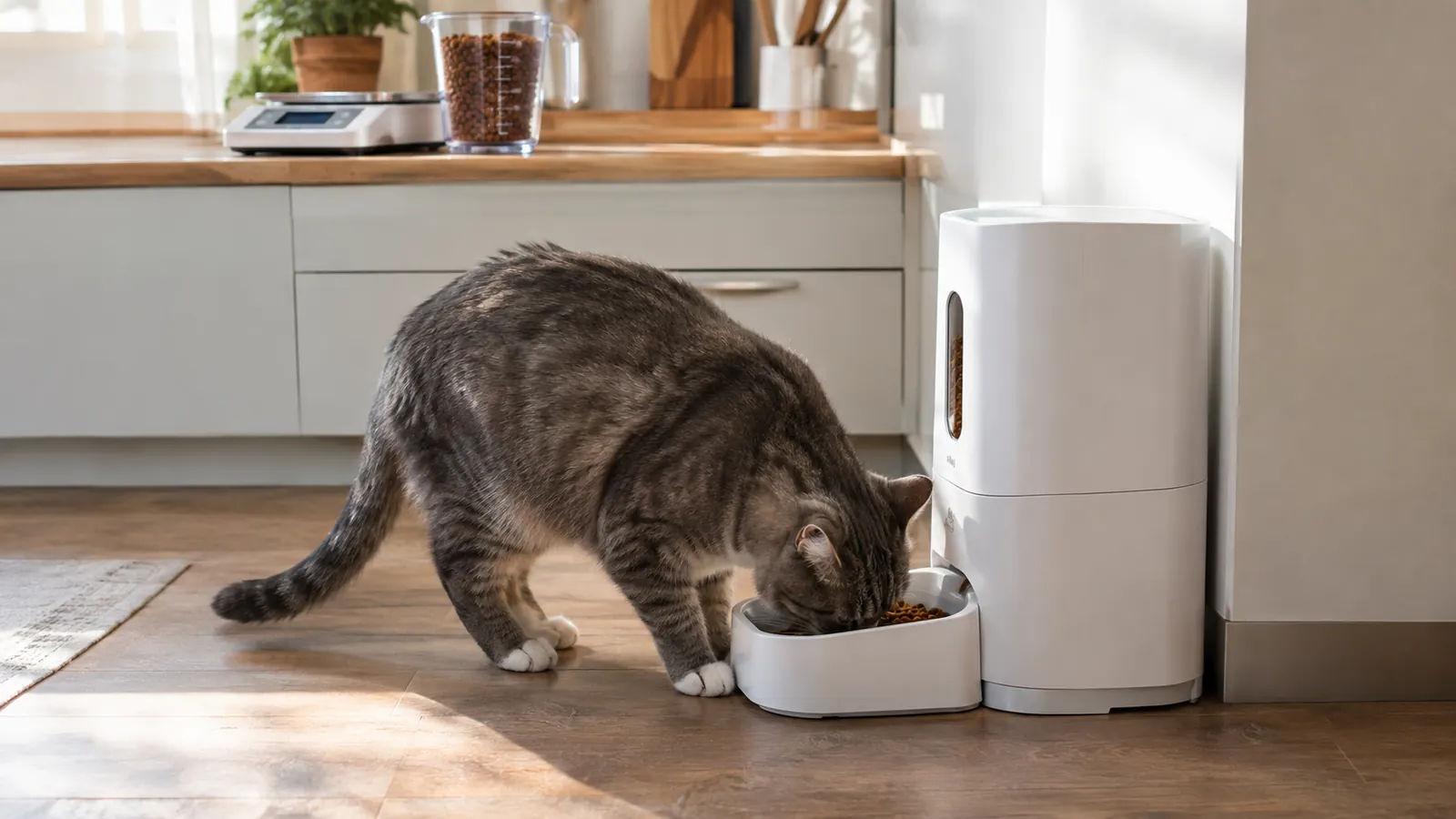
Where you put the feeder matters more than you would think. I first set ours in the corner of the kitchen near the back door, because that was where Juniper's old bowl lived. Bad idea. The back door gets opened a hundred times a day, the corner is drafty, and Juniper would not go near it for two days. I moved the feeder to a quiet spot against the kitchen wall, away from the door and the washing machine, and she started eating from it within the hour.
Cats like to eat where they can see the room, not where they feel trapped. Put the feeder somewhere with a clear view of the kitchen or living area, on a flat, stable surface, and keep the area around it clean. I put a washable mat under ours, because Juniper is a messy eater and I am the one who scrubs kibble dust off the floor. The feeder itself is easy to wipe down, and the stainless tray comes out for a rinse, which matters when you are feeding a cat who eats like she is being timed.
Keep the feeder away from heat and direct sun, and do not crowd it against the wall, because the lid needs to open and the hopper needs to come off for refilling. I refill ours about once a week, and I have learned to do it over the sink, because the first time I refilled it over the counter I scattered kibble across the kitchen like I was feeding birds.
Step 5: Watch the first two weeks and adjust like a scientist
The feeder is not a set-and-forget machine, at least not at first. For the first two weeks, I weighed Juniper once a week on the baby scale we keep in the bathroom, and I kept a little notebook by the feeder. I wrote down the dial setting, the grams per meal, and any day she left food in the tray. That notebook is the reason we caught a problem early: after about ten days, Juniper was leaving part of her lunch uneaten, which for her is like a human leaving half a steak on the plate. I cut the lunch portion by a few grams, moved those grams to dinner, and she cleaned her tray again.
The signs that the portion is wrong are usually visible before the scale catches it. If your cat is gaining weight, the portion is too big. If she is losing weight, or acting hungry between meals, the portion is too small. If she is eating every meal and still crying at the feeder an hour later, she might be bored, not hungry, which is a whole different conversation. Give any adjustment a week before you change it again, because cats need time to settle into a new routine, and you need time to see whether the change actually worked.
After six weeks on the Voluas schedule, Juniper was back to the weight my vet was happy with, and she had stopped acting like a starving orphan every afternoon. The feeder did not do that by itself. The schedule did, and the feeder made the schedule possible by taking the guesswork out of every single meal. That is the real win: not the machine, but the routine the machine lets you keep.
What Else Helps
A few small things made the portion control routine stick. I weigh Juniper's food with a cheap kitchen scale for the first few days after any food change, because the same volume of a new kibble can weigh differently. I keep the feeder's tray clean, because a dirty tray can make a picky cat skip a meal and then act hungry an hour later. And I stopped free feeding entirely, which was the hardest change of all. Juniper used to have a bowl of kibble available all day, and she grazed, and she gained weight, and I told myself it was fine because she was eating 'whenever she wanted.' The Voluas feeder ended that argument for good, because now the food arrives on a schedule, and Juniper has decided the schedule is trustworthy. If you are trying to portion control a cat who has spent years free feeding, expect a few days of dramatic complaining at the empty bowl. Ignore it. The dramatic complaining stops, and the weight comes off.
The feeder did not fix Juniper's portions. The schedule did. The feeder just made the schedule possible by taking the guesswork out of every single meal.
Give your cat the same portion every day, without thinking about it
The Voluas Automatic Cat Feeder holds a week of kibble, dispenses measured portions on a schedule you set, and has made feeding time boring and predictable in the best way. That is exactly what a portion control routine needs.
Amazon Check Today's Price on Amazon →