
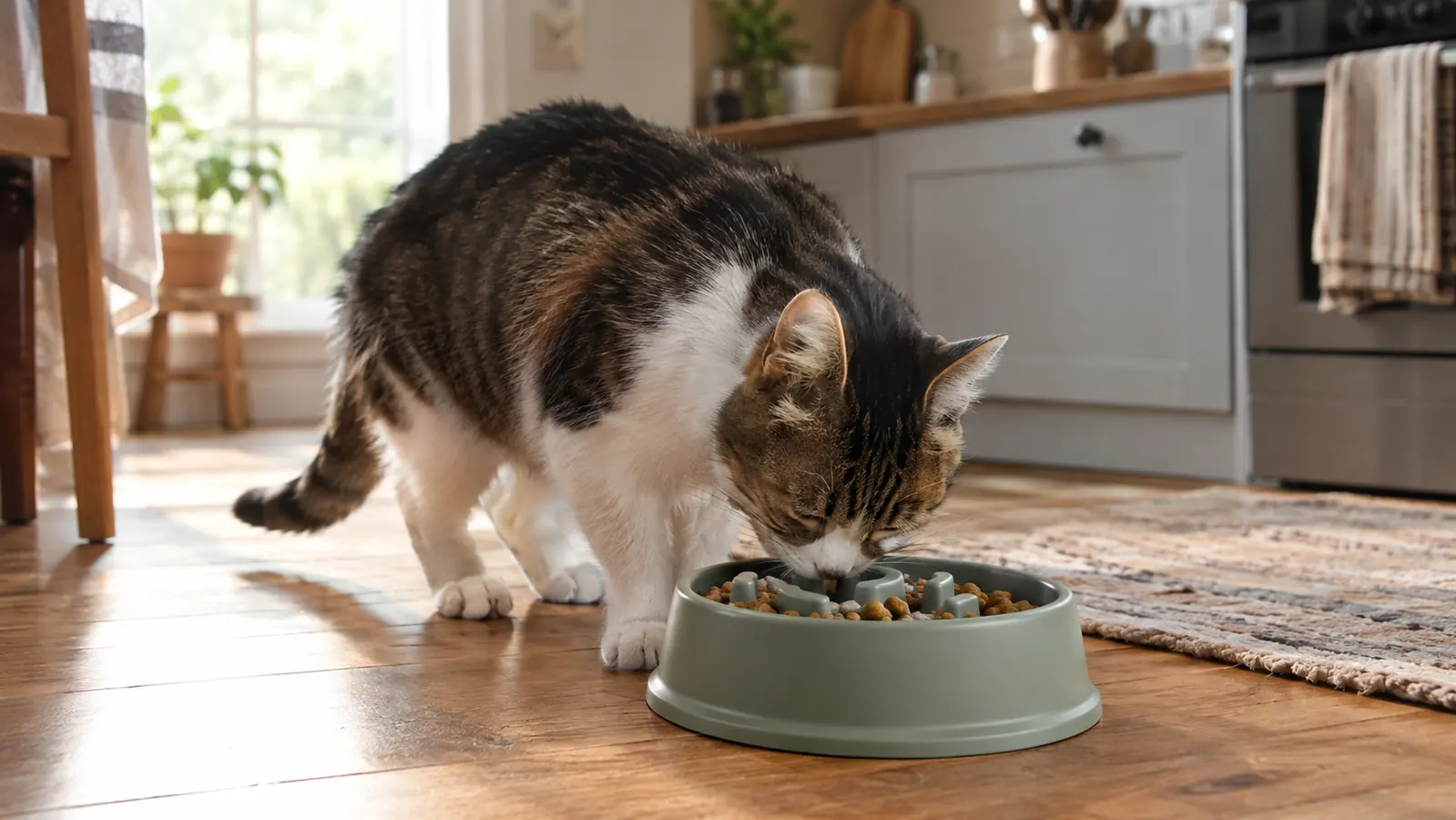
Juniper has a talent for turning a calm meal into a small emergency. She is an 11-year-old gray tabby, about 11 pounds, and for most of her life she treated dinner like a timed race. Kibble disappeared in seconds. Then came the regrettable part, the quiet heave on the living room rug, and the cleanup I could have done without at seven in the morning.
I have worked the front desk at a small-animal clinic in Allentown for twelve years, so I have heard this exact story from a hundred owners. It is not a medical mystery and it is not stubbornness. Some cats simply eat too fast, and fast eaters often pay for it. What finally slowed Juniper down was not a fancier food or a prescription. It was a simple change of bowl. The Catstages slow feeder bowl does one job and does it well, and after a few months of daily use I have a full list of reasons it earns its spot on our kitchen floor.
The bowl that finally slowed down our fast-eating tabby
If your cat inhales dinner and then regrets it, this is the low-cost change worth trying first. Juniper took to it faster than any puzzle feeder we have owned.
Amazon Check Today's Price on Amazon →It turns one big gulp into lots of small ones
The whole point of a slow feeder is to put a little friction between a cat and her dinner. The Catstages bowl has raised sections across the bottom, so Juniper cannot scoop up a mouthful the size of a walnut. She has to pick around them, which sounds like a small thing. It is not. Her eating time went from under a minute to about four, and the frantic gulping stopped almost overnight. That is the whole job, and this bowl does it without any fuss.
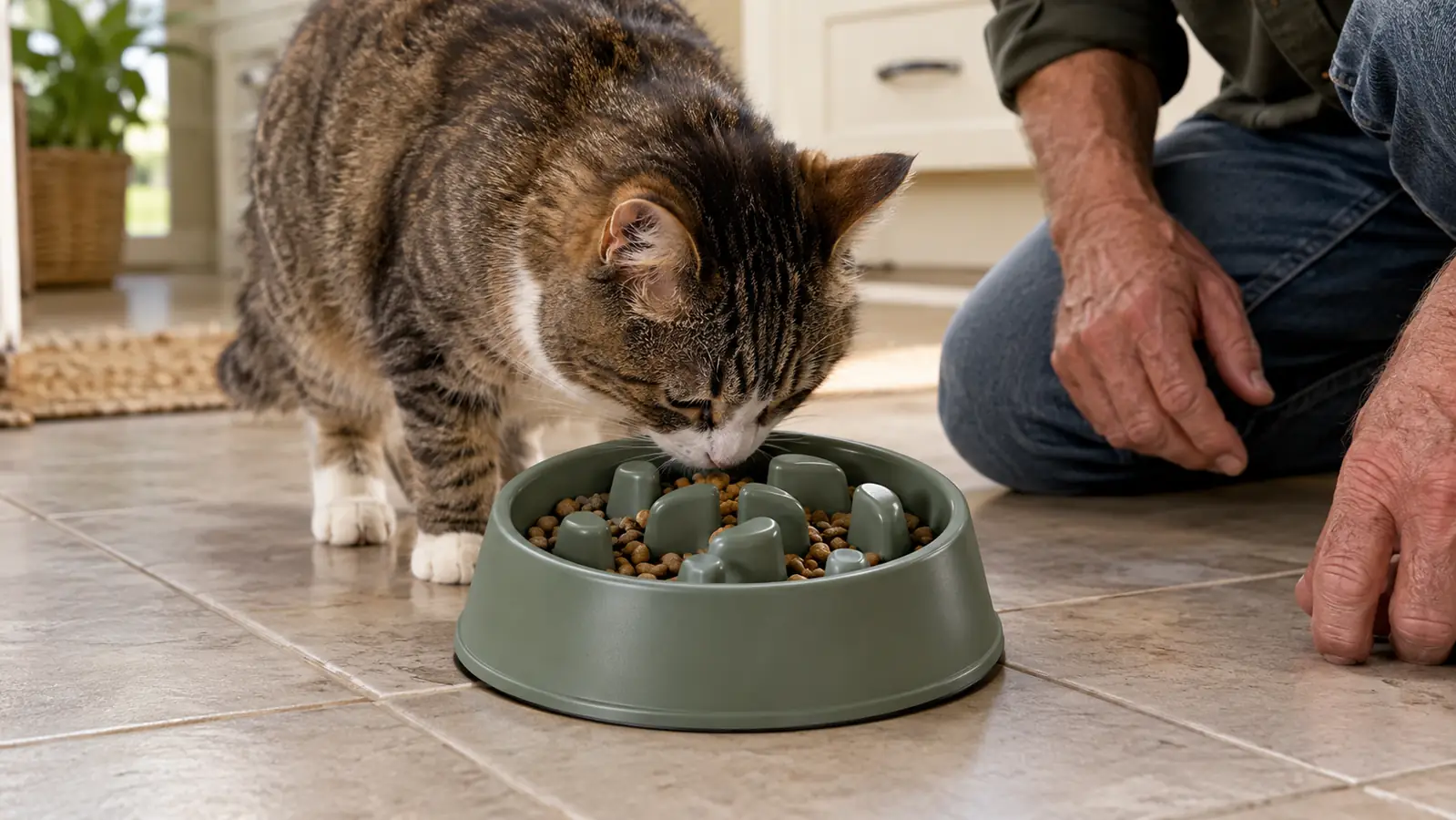
Picky cats do not feel punished by it
I have bought puzzle feeders that Juniper looked at once and then ignored for weeks. She is not a cat who enjoys working for her food, and I stopped pretending otherwise. What surprised me about the Catstages bowl is that she never treated it as a toy or a challenge. It is just a bowl with some texture inside. Her food is still right there, easy to reach, no tricks. A picky cat will eat from a bowl that looks like a bowl, and that is exactly what this is.
Fewer scarf and barf mornings
At the clinic we call it eating too fast syndrome, and the classic result is a cat who throws up whole kibble shortly after eating. Juniper used to do this a few times a week. Slowing her down gave her stomach time to keep up with her enthusiasm. We still have the occasional hairball, because she is a cat, but the rushed, food-related cleanup has basically disappeared from my routine. That alone was worth the switch.
The three quarter cup size keeps portions honest
The bowl holds about three quarters of a cup, which is the right serving for a cat Juniper's size. I like that the bowl does the measuring for me. I fill it, I know she is getting her normal amount, and I do not have to eyeball a wide dish and wonder whether I overdid it. Portion control matters more as cats get older, and a bowl that naturally matches the right amount makes my job easier at six in the morning.
Whiskers get a break at mealtime
Cats have sensitive whiskers, and a deep, narrow bowl presses them against the sides while the cat eats. Some cats dislike that so much they refuse to finish their food. This bowl is 5 inches across, which is wide enough that Juniper's whiskers do not brush the rim as she eats. It sounds like a minor comfort, but for a picky cat it can be the difference between a clean bowl and a half-eaten meal that ends up in the trash.
The base stays put on the kitchen floor
A bowl that slides across the floor while a cat eats is a bowl that makes a mess. Juniper used to push her old dish in a slow arc, scattering kibble as she went. The Catstages bowl holds its place where I set it, even when she gets a little aggressive with her eating. That means less sweeping, fewer stray pieces under the fridge, and a floor that does not need attention after every meal.
It cleans up fast, so I actually use it
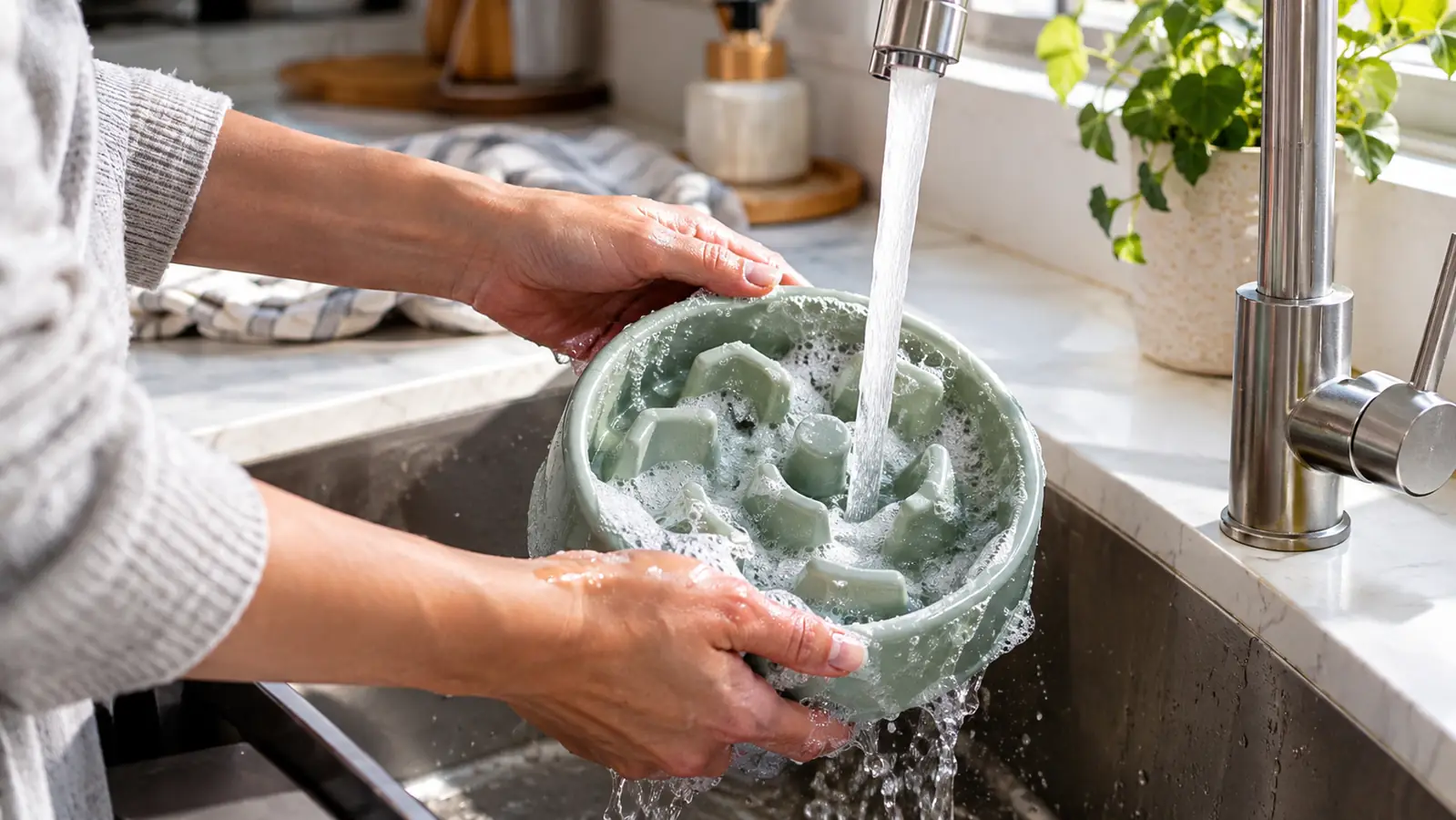
The best feeding tool in the world is worthless if it is annoying to wash, because you will stop reaching for it. This bowl rinses clean in seconds. There are no narrow gaps that trap wet food and no hidden corners where kibble dust gathers. I wash it with the rest of the dishes and it is dry by the next meal. Months in, that ease is the reason it is still in the rotation and not buried in a cabinet with the other experiments.
It works for wet food, not just kibble
Juniper gets a mix of dry food and a little canned food, and I worried a slow feeder would only help with kibble. It turns out the raised sections slow her down just as well with wet food, because she still has to eat around them. Her wet food breakfast now takes a few minutes instead of a frantic thirty seconds. If your cat eats both, you do not have to choose between slowing her down and feeding her what she likes.
It fits a small house without taking over
We live in a small two-bedroom house, and I do not have room for a feeding station the size of a coffee table. The 5 inch bowl tucks into a corner of the kitchen next to the water dish without crowding anything. It looks tidy, which matters to me, and it is easy to pick up and move when I mop. For a modest little bowl, it manages to be both useful and unobtrusive.
The hungry again act finally stopped
When Juniper wolfed her food in thirty seconds, she would wander back to her empty bowl ten minutes later and cry like she had been starved. Part of that was habit, but part of it was that her stomach had not registered the meal yet. Eating slowly changed that loop. She finishes breakfast, walks away, and does not come back to complain until dinner. That quiet is the most underrated benefit of this whole experiment.
What I'd Skip
Honestly? If your cat already eats at a normal pace and never throws up after meals, you do not need this bowl. It is a tool for a specific problem, not a fix for every cat. I would also skip it if you have a cat who refuses to eat from anything that is not a familiar flat dish, because a few stubborn eaters will walk away rather than adapt. And if your cat throws up more than once a week, skip the bowl and call your vet. That is worth a real checkup, not a feeding change.
Her eating time went from under a minute to about four, and the frantic gulping stopped almost overnight.
The low-cost change that stuck in our kitchen
If your cat gulps dinner and pays for it later, the Catstages slow feeder bowl is a small, affordable experiment with a high success rate. Juniper has used ours every day for months.
Amazon Check Today's Price on Amazon →