
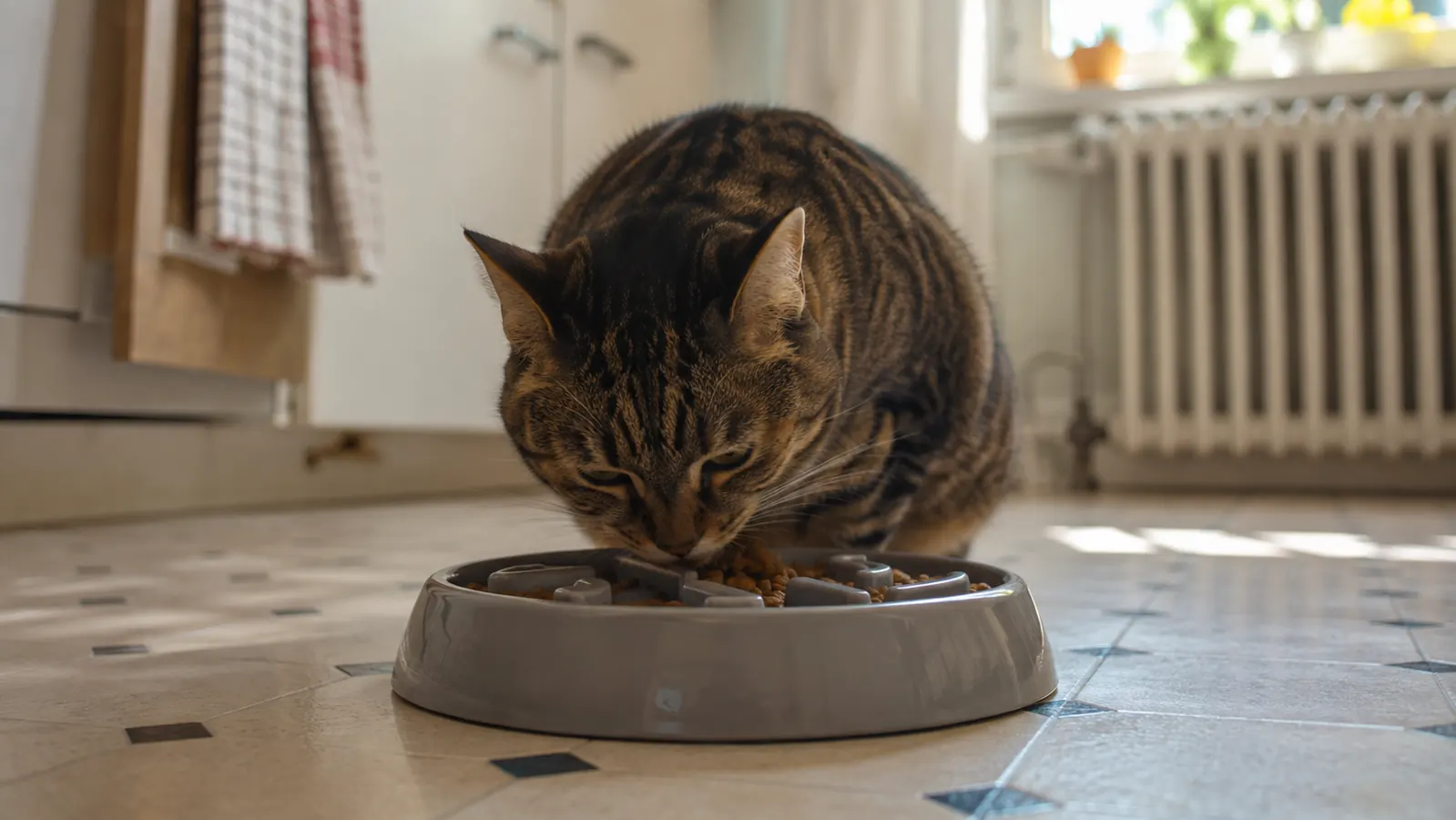
I have worked the front desk at a small animal vet clinic for twelve years, so I have watched a lot of cats eat, and I have also watched a lot of owners pretend their cat does not inhale food. My own cat Juniper is an 11-year-old gray tabby, about 11 pounds, and she is the reason I finally bought the Catstages slow feeder bowl. She gulps her kibble like she is afraid someone is going to take it, and after one particularly alarming dinner where she coughed up her whole meal on the kitchen rug, I decided to try something. This is my honest review after eight weeks of daily use, and I am going to tell you the parts nobody puts in the product description.
I am not a vet and I am not a vet tech. I am the person who books your appointments and listens to you describe cat problems in the waiting room. So everything here is what I observed in my own house with my own cat, plus what I have learned from watching hundreds of cats eat over the years. If your cat has a medical reason for eating too fast, talk to your vet first. If your cat is just a goblin about food like mine, keep reading.
The Quick Verdict
The Catstages slow feeder bowl genuinely slowed Juniper down from inhaling her dinner in under a minute to taking about five minutes, with fewer throw-ups and a lot less drama. It is not magic, it is not a puzzle that will entertain her for hours, and it is not indestructible. But it solved the problem it claims to solve, and I would buy it again.
Amazon Check Today's Price →If your cat inhales food and then throws it up, this is the simple fix that worked for us
Juniper went from finishing her whole meal in under a minute to taking about five minutes, and the post-dinner throw-ups stopped within the first week. The Catstages slow feeder bowl is a simple, wide, shallow dish with raised ridges that force your cat to actually work for each piece of kibble.
Amazon Check Today's Price on Amazon →How I've Used It
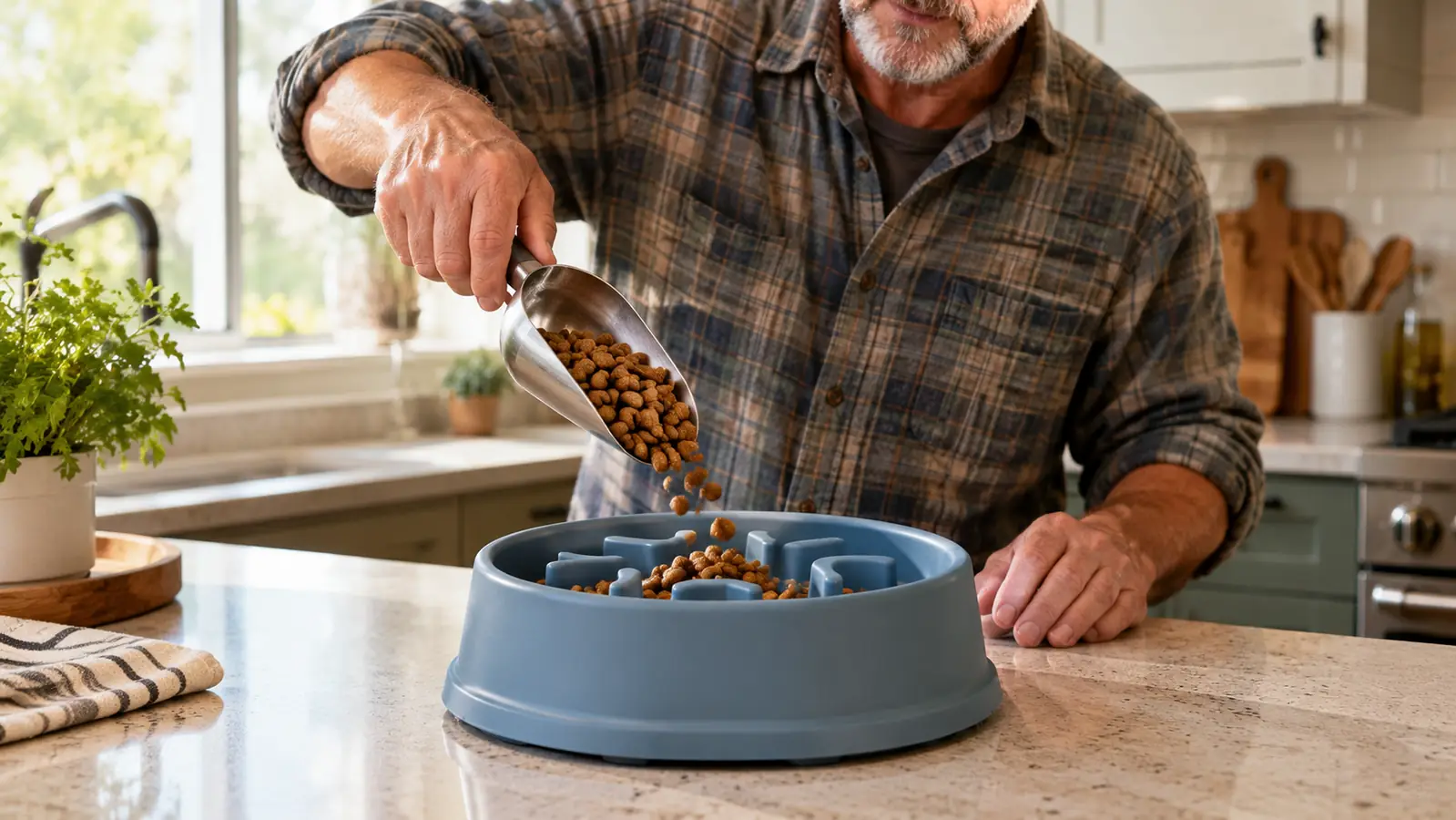
Here is exactly what I did, because the way you use this bowl matters more than people think. I started Juniper on dry kibble only, no wet food, because the ridges work best with pieces that can sit between them. Her regular food is a grain-free chicken kibble, and I measured out a half cup using the same 1/4 cup scoop I have used for years, because I did not want the new bowl to change her portion size. I set it on the kitchen floor in the same spot where her old bowl lived, up against the wall in the corner, and I did not switch anything else about her routine. Same food, same times, same amount. The only variable was the bowl itself.
The night I ordered it, Juniper had thrown up her dinner for the third time that month. She finished her meal in maybe forty-five seconds, walked two steps away from the bowl, and then coughed the whole thing up onto the kitchen rug. Glen stepped in it on his way to the coffee maker the next morning, and that was the last straw. I ordered the Catstages bowl that same day, and it arrived two days later.
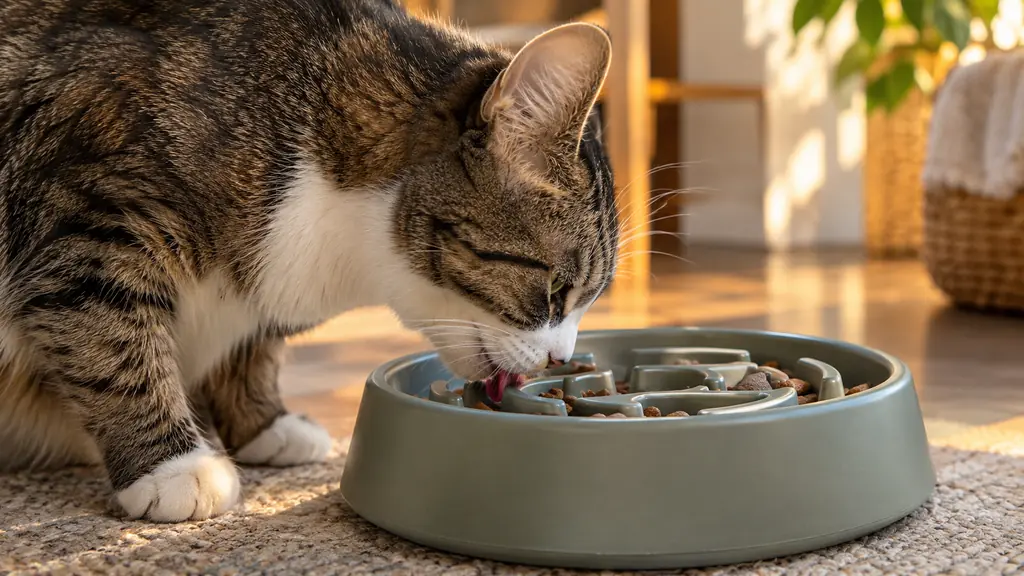
The first time she ate from it, she stared at me like I had personally offended her. She pawed at the bowl, flipped a few pieces of kibble onto the floor, and then figured out she had to eat around the ridges. That first meal took her about eight minutes. By the end of the first week, she had it down to about five minutes, which is still a huge change from the under-a-minute scarfing she used to do. By the third week she had a system: she hooks the edge pieces with her tongue, then works the center in a clockwise circle. Watching her is honestly a little funny.
I used it twice a day for eight weeks, which is 112 meals, and I washed it in the dishwasher at least three times a week. It came out clean every time, no warping, no melted plastic, no weird smell. I also hand washed it a few times when I was too lazy to run the dishwasher, and the ridges are shallow enough that a sponge gets into all of them without a brush. One thing I learned the hard way: if you let the bowl sit with wet kibble stuck in the ridges overnight, it takes a little scrubbing. Rinse it right after dinner and you will never think about it again.
What Nobody Tells You Before You Buy It
Here is the part I wish someone had told me: this bowl does not make eating a game. It is not a puzzle feeder. It is a speed bump. Your cat will not be entertained for an hour, she will be mildly annoyed for five minutes. Juniper finished her meals faster than I expected, because once she learned the pattern, she just ate around the ridges efficiently. If you are hoping for a toy that will keep your cat busy, this is not that. If you want your cat to stop inhaling food so fast that it comes back up, this does the job. And the first week, I kept waiting for her to get bored and refuse to eat. She never did. She grumbled, but she ate every single piece.
The second thing nobody tells you: some cats just flip the bowl. Juniper is a polite eater, so she never did, but I have seen it happen with clinic cats and I have read enough reviews to know it is common. The bowl is wide and shallow, which makes it stable for most cats, but a determined or playful cat can absolutely tip it. If your cat is a flipper, you will need to hold the bowl or set it against a wall. I set Juniper's bowl in the corner of the kitchen, with the wall on one side and the cabinet on the other, and I never had a problem. But I want you to know the risk exists, because a flipped bowl means kibble all over the floor and a cat who looks very proud of herself.
The third thing nobody tells you is how much noise this bowl makes. Kibble hitting the plastic ridges sounds like someone shaking a box of pebbles. The first few nights, Glen looked up from the couch every time Juniper started dinner, and I got used to the click-click-click of her eating in the kitchen. It is not a bad sound, it is just a sound you do not expect from a cat bowl. If you are a light sleeper and your cat eats in the bedroom, keep that in mind.
The fourth thing: the ridges do not slow down every cat the same way. A very determined cat will learn to eat around them quickly, sometimes in two or three meals. The bowl slows down a gulper, but it does not turn a determined gulper into a dainty nibbler. Juniper still eats faster than I would like, she just eats about five times slower than she used to, and that is enough to stop the throw-ups. If your cat is an especially fast and determined eater, you may need to pair this bowl with smaller, more frequent meals. That is what we do at the clinic for the worst gulpers.
Juniper went from finishing her dinner in under a minute to taking about five minutes, and the throw-ups stopped within the first week. That is the whole review.
The Ridges, the Size, and the Cleanup
Let me describe the bowl itself, because the photos on Amazon do not give you a good sense of scale. I measured it before I put it away the first night: it is about five inches across and maybe an inch and a half deep at the center, with raised ridges that curve through the middle like the inside of a shell. The kibble settles between the ridges, so your cat has to eat around each raised section to reach the pieces. It is not deep, which is good, because cats with sensitive whiskers often refuse to eat from deep bowls. Juniper never had a problem with whisker fatigue on this one, and she is a cat who hates having her whiskers touched. The wide, flat shape means her face stays out of the bowl, and only her tongue does the work. The ridges are tall enough to slow her down but not so tall that she gives up, and that balance is the whole reason the bowl works.
The bowl holds about three quarters of a cup of kibble, which matches the product description. For Juniper, that is exactly one meal. If you have a bigger cat or a cat who eats more than that per meal, you will need to refill it or split the meal into two rounds. It is not a bowl for a cat who eats two cups at a time. It is a bowl for a cat who needs to slow down, and it works best with dry food. I would not use it for wet food, because pate and shredded food smear into the ridges and turn cleanup into a project. Dry kibble is what this bowl was designed for, and dry kibble is what it does well.
Cleanup is genuinely easy, and I say that as someone who has owned a lot of cat bowls over the years. The plastic is smooth, the ridges are rounded, and nothing gets stuck in a way that requires a toothbrush. I put it in the dishwasher on the top rack at least three times a week and it came out spotless every time, no warping and no smell. I also noticed it does not slide around on the floor, because the bottom has a non-slip grip that grabs the linoleum. That matters more than you think, because a bowl that slides across the kitchen while your cat eats is a bowl that ends up flipped. The only cleanup quirk: kibble dust collects under the bowl, so I sweep that corner of the kitchen a little more often than I used to. One more thing: the bowl is light enough to pick up with one finger, so if your cat is a flipper, the weight will not save you. The grip on the bottom helps, but it is not a lock.
How It Affected Juniper's Eating, Digestion, and Mood
The most important change was behavioral, and it showed up fast. Juniper used to eat so fast that she would sometimes cough and gag right after dinner, and in the month before I ordered this bowl she threw up her entire meal on the rug three times. The third time was the night I ordered it. After she started eating from the Catstages bowl, the throw-ups stopped within the first week, and we are now eight weeks in with zero incidents. I kept a little tally on the calendar for the first two weeks, partly because I did not believe it would work and partly because I wanted to be able to tell you honestly what happened. Day one, no throw-up. Day four, no throw-up. By day fourteen, I stopped keeping the tally. She still eats quickly by human standards, but the ridges force her to pause between pieces, and that pause is enough for her stomach to keep up.
The second change was that she seemed less hungry after meals. I know that sounds backwards, because she is eating the same amount, but there is a difference between inhaling food and actually registering that you have eaten. When she ate in under a minute, she would immediately come looking for more, and she would follow me around the kitchen meowing like I had forgotten to feed her. Now that she eats over five minutes, she licks her paws, walks away, and takes a nap in the sun by the back door. That alone made the purchase worth it for me, because the begging was wearing on both of us.
The third thing I noticed was her weight, and this is where I have to be careful. Juniper is 11 pounds, and at her checkup last spring the vet said she was getting a little chunky and asked me to watch her portions. I did not change her portion size when I switched to the slow feeder, so I cannot honestly say the bowl caused any weight loss. What I can say is that she stopped acting hungry all the time, which made it much easier for me to stick to her portion and say no to the begging. If you are trying to help your cat lose weight, the bowl is a tool, not a diet. It helps you feed the right amount without the drama, but the amount is still up to you.
What I Liked
- Genuinely slows down a fast eater: Juniper went from under a minute to about five minutes per meal
- Stopped the post-meal throw-ups within the first week, and they have not come back in eight weeks
- Easy to clean: dishwasher safe, no warping, and the ridges are shallow enough for a sponge
- Wide and shallow, so it does not bother cats with sensitive whiskers
- Non-slip base keeps the bowl from sliding across the floor
- Simple and low-tech: no batteries, no parts, nothing to break
Where It Falls Short
- It is a speed bump, not a puzzle: some cats learn to eat around the ridges in just a few meals
- Some cats will flip the bowl if it is not set against a wall or held
- Only really works with dry kibble; wet food smears into the ridges and gets messy
- Holds only about three quarters of a cup, so big eaters need refills or smaller portions
- The clicking noise of kibble hitting the plastic takes some getting used to
Who This Is For
Buy the Catstages slow feeder bowl if your cat inhales food and then throws up, if your cat is a food-obsessed goblin who acts starving after every meal, or if you have a kitten who is still learning to eat at a normal pace. It is also a good choice if you want a simple, low-tech way to slow your cat down without buying an electronic feeder or a complicated puzzle. It is one of the simplest tools I have used in twelve years of watching cats eat.
Who Should Skip It
Skip it if your cat eats wet food only, because the ridges do not work the same way with pate or shredded food, and the mess is not worth it. Skip it if your cat is a bowl flipper, unless you are prepared to hold the bowl or wedge it against something. Skip it if you are looking for a long-lasting puzzle toy, because this is a speed bump, not a game. And definitely skip it if your cat has dental pain, mouth pain, or any medical reason for eating differently, because a slow feeder will not fix that. Talk to your vet.
The bottom line: if your cat gulps and throws up, try this before you buy anything fancier
Eight weeks in, the Catstages slow feeder bowl is still in our kitchen, and Juniper is still eating from it twice a day. It is not magic, it will not fix every cat's eating problem, but it solved the exact problem I bought it for, and I would buy it again.
Amazon Check Today's Price on Amazon →